Role of NGOs in Reducing Social Inequality
By Sarvsambhaav Social Foundation (SSF)
Introduction
Social inequality remains one of the most pressing challenges in modern society. Differences in income, education, healthcare access, and social opportunities continue to create gaps between communities. While economic growth has improved many lives, a significant section of society still struggles to access basic resources and equal opportunities.
Non-Governmental Organizations (NGOs) play a crucial role in bridging this gap. Through grassroots initiatives, awareness programs, and community support, NGOs work directly with people who need assistance the most. Sarvsambhaav Social Foundation (SSF) is committed to reducing social inequality by empowering communities and promoting inclusive development.
Understanding Social Inequality
Social inequality refers to the unequal distribution of resources, opportunities, and privileges within society. It can appear in many forms, such as:
Limited access to quality education
Financial instability and unemployment
Lack of healthcare awareness
Gender and social discrimination
Digital and financial exclusion
These inequalities often create long-term cycles of poverty and social exclusion, making it difficult for individuals and families to improve their living conditions.
Why NGOs Are Essential in Addressing Inequality
NGOs operate at the grassroots level, allowing them to understand real community challenges better than large institutions. Their flexible and people-focused approach helps deliver targeted solutions.
Key reasons NGOs are vital include:
✅ Direct connection with local communities
✅ Faster response to social issues
✅ Focus on awareness and empowerment
✅ Ability to reach underserved populations
✅ Encouraging community participation
By working closely with communities, NGOs help ensure that support reaches those who are often overlooked.
How NGOs Reduce Social Inequality
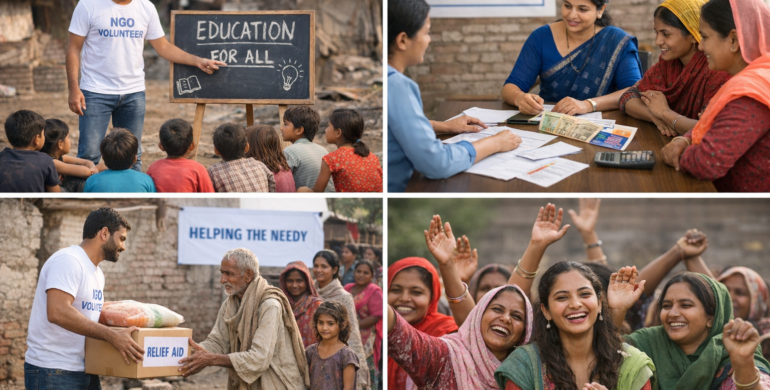
1. Promoting Education and Awareness
Education is one of the strongest tools for equality. NGOs organize awareness programs, learning initiatives, and skill-development activities that help individuals gain knowledge and confidence to improve their lives.
2. Encouraging Financial Inclusion
Many families lack access to financial knowledge and resources. NGOs promote financial literacy, responsible money management, and awareness of government schemes, helping people achieve economic stability.
3. Supporting Vulnerable Communities
Through welfare programs and relief initiatives, NGOs provide essential support during difficult times, ensuring that basic needs are met while guiding communities toward long-term independence.
4. Empowering Women and Youth
Empowerment programs encourage participation, leadership, and skill development among women and young individuals, enabling them to become active contributors to society.
5. Building Community Networks
NGOs strengthen social bonds by encouraging collaboration and mutual support within communities, creating sustainable systems of collective growth.
Sarvsambhaav Social Foundation’s Approach
At Sarvsambhaav Social Foundation (SSF), the mission is rooted in the belief that every individual deserves equal respect and opportunity. The organization works toward reducing inequality through:
Community welfare initiatives
Social and financial awareness programs
Support drives for underserved communities
Inclusive initiatives promoting equality and dignity
SSF focuses not only on providing assistance but also on empowering individuals to become self-reliant and confident members of society.
The Long-Term Impact of NGO Efforts
When NGOs work consistently within communities, the results extend far beyond immediate relief:
Improved education and awareness levels
Increased financial stability
Stronger and more connected communities
Reduced social discrimination
Greater participation in social development
These outcomes help create a more balanced and equitable society.
How Individuals Can Contribute
Reducing social inequality is a shared responsibility. Individuals can support change by:
Volunteering with NGOs
Supporting awareness campaigns
Encouraging inclusive practices in daily life
Contributing skills, time, or resources
Spreading awareness about social causes
Every contribution, no matter how small, helps build a more equal society.
Conclusion
Social inequality cannot be eliminated overnight, but collective efforts can significantly reduce its impact. NGOs act as bridges between resources and communities, ensuring that development reaches everyone, not just a few.
Sarvsambhaav Social Foundation (SSF) continues to work toward creating an inclusive society where equality, compassion, and opportunity guide progress. Together, through awareness, participation, and shared responsibility, we can build a future where no one is left behind.